
Canby’s ‘model’ citizen enjoys making boat replicas

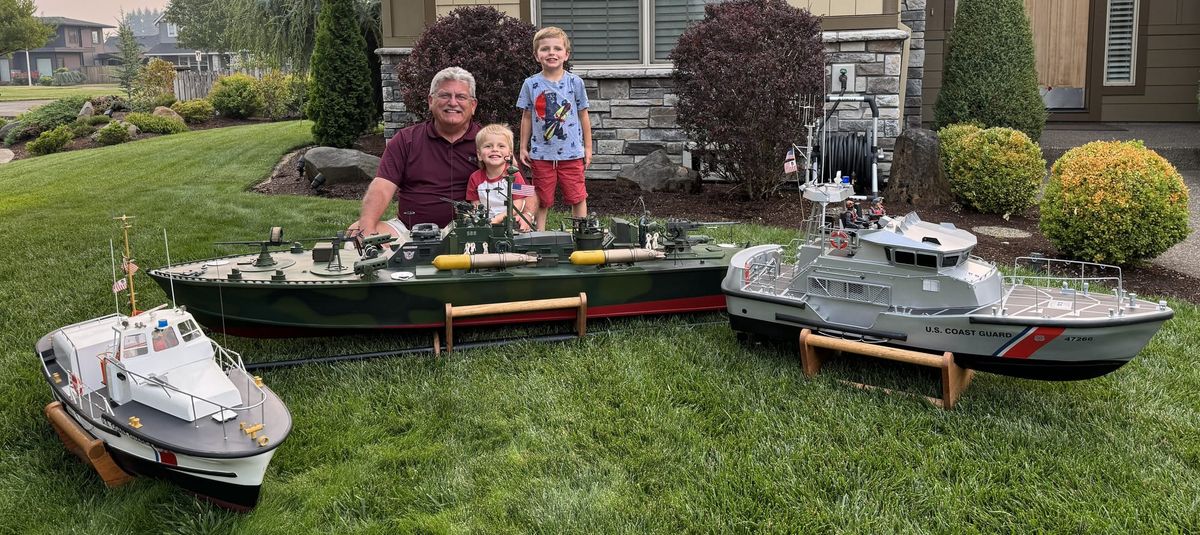
By Raymond Rendleman, The Canby Chronicle
He does it for fun, but Randy McGuire also gets to connect with history and family by taking his model-boat hobby to levels beyond the comprehension of most fellow Canby residents.
These are not the model boats you might buy in a kit at a local hobby shop. McGuire custom builds his models from scratch after studying the Coast Guard or U.S. Navy specifications for historic watercraft.
One of McGuire’s models is based on the 44-foot motorized lifeboat on display at the Maritime Museum in Astoria. Invented during the 1960s and remaining in service as Coast Guard workhorses well into the 21st century, these were the first lifeboats designed to automatically right themselves if overturned, while allowing a single crew member to handle a throttle and steering wheel simultaneously. The Coast Guard built over 100 of these vessels until they were decommissioned and gradually replaced by 47-foot modernized versions between 1997 and 2009. (McGuire has built a model of the newer version as well.)
“When I'm fishing or crabbing, I see them out in the water, and I consider those guys to be heroes for what they do,” he said.
McGuire’s models are built on 1/12th scale, so the resulting lifeboat models come out to 44 or 47 inches (just under 4 feet). McGuire can move around these approximately 40-pound models himself.
McGuire built the lifeboat models using pieces of wood and metal in his own garage, but he downplays the amount of skill required for his hobby.
“It doesn't matter if it's imperial or metric; it's just a bit of a math problem no matter how you cut it,” he said.
McGuire mentioned his hobby to fellow members of the Canby Rotary Club, and now they want him to do a presentation. If the publisher of the Canby Chronicle hadn’t been in attendance at the meeting, McGuire’s hobby might have remained under the radar forever.
“It's just something fun to do, and I don't advertise it or anything,” he said.
It all started when McGuire was a little kid, he remembers taking little pieces of scrap wood and floating them on lakes and streams. “It's always been something that fascinates me,” he said.
McGuire’s father was a sailor in WWII and would always have stories about working on boats during the war. McGuire helped his dad build a couple of full-sized boats.
Inspired by his father’s tutelage, McGuire built a 17-foot canoe, but he has since sold that custom canoe he built in order to buy a Harley. His current fishing boat was commercially constructed. It wasn’t until after his father’s death in 2001 that McGuire’s model building hobby really took off.
“After the war, my father was a commercial contractor who owned and built boats, but I took it to a level that he never thought about in terms of the models,” McGuire said.
McGuire’s third 1/12th scale model depicts an 80-foot WWII PT boat that carried 17 crew members operating machine guns, torpedoes, and rocket launchers while traveling at 41 knots (about 47 mph). At about 60 pounds, the PT model is too long to move solo, so he devised a frame that can be removed from the cradle that the boat is set on, so two people can lift and move it.
McGuire found that he needed to build the propellers at a much higher diameter than the scale would suggest and rotate them at much higher speed in order to have fun with his model on a pond. To match the scale of the two-foot propeller on the original boat, a two-inch propeller would be completely inadequate for getting the model to move. And while the original boat would have had a 2,500-3,000 rpm motor, McGuire’s motor runs at 10,000 rpm.
“A mathematician could probably tell us why this is the case, but it's just a trial and error thing for me since it's a hobby,” he said.
McGuire’s next project will be 1/96th scale model of the ship that his father served on in WWII, the U.S.S. Lowndes amphibious marine assault ship, built either in the Kaiser shipyard in Vancouver or on Swan Island. His father served as one of the coxswains who would drive landing crafts ashore.
McGuire is the director of development for a mission organization called Path International. “People try to separate what you do from what you are, but I'm a big believer that they go hand in hand,” he said. “Part of the fun of it is figuring it out along the way and looking at it without fear, and rather with problem solving.”