Chief: ‘No tolerance’ for loss of life on Molalla River

By Raymond Rendleman, The Canby Chronicle
Canby Community Park is an idyllic spot for a swim and a picnic, but it’s also the deadliest spot in town.
This year, Canby Fire District Chief Matt Dale decided to see for himself how this Molalla River location claims so many lives. Dale recruited his training officer and the district’s fire marshal to explore this area.
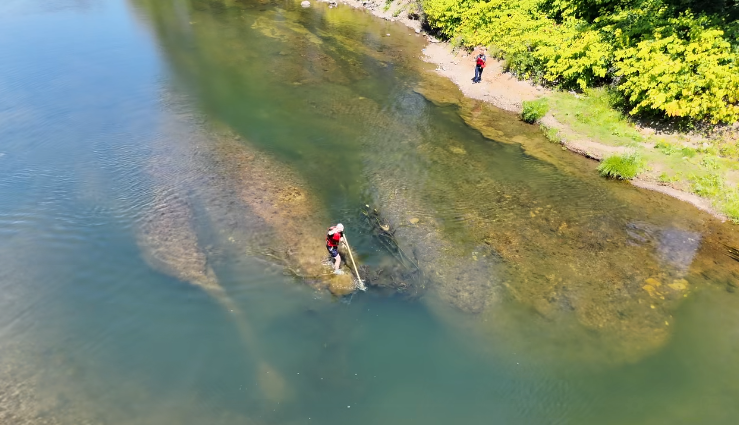
With the aid of a drone and an 8-foot pole, they set out into the water. In the last 30 years, it’s rare to go a year without a drowning victim in this exact spot. There’s already been a drowning this year, and three deaths and one near-drowning last year. No other spot on the Molalla River involves such regular drownings.
After the Kittyhawk explosion in February, the fire district has purchased a drone to view areas from above without borrowing equipment from other agencies. While investigating the explosion of an argon gas tank at a Canby-based aerospace supplier, the drone proved useful to the fire district, as well as for their visit to the Molalla River.
Dale was wearing trail running shoes with better-than-average grip, but he still had trouble staying upright on the river rocks. He saw how the rock is slippery enough for someone to easily lose their footing.
“It was a really slippery surface out in that river,” Dale said.
Canby Community Park doesn’t get the notoriety of other locations in Clackamas County like Oxbow Park on the Sandy River or High Rocks Park in Gladstone. But Dale would like to see more citizen awareness about the dangers of the Molalla River, especially at this spot, to prevent future drowning deaths.
“It’s a preventable, needless loss of life that we at the fire district have no tolerance for,” he said.
Dale can now imagine how someone could slip on the rocks and quickly get sucked 10 feet deep under the water, based on how the 8-foot pole was pushed an arm’s length underwater to find the bottom of the dropoff. From above, the drone saw through the Molalla’s clear water to how the rock creates a dramatic shelf, a mostly underwater 10-foot waterfall.
Canby Fire District has rescued a few patients from near drownings at the location, but nobody remembers slipping. Dale said that it’s typical of drowning victims to lack any memory of what transpired in the minutes before they lost consciousness.
Once you lose your grip on the rock, survival is slim. Dale credited “some very heroic actions by the public in years past” that have saved lives at the location, including an off-duty nurse who rescued a drowning victim and started chest compressions until emergency equipment arrived.
“What makes it especially difficult for us is the access because it’s right next to private property so we have to hike in with the equipment, and sometimes the only way to get a patient out is by floating them out,” Dale said.
By law, navigable rivers in Oregon have public access along their banks for citizen enjoyment of the waterways, but these banks are often difficult and slow to traverse for emergency technicians approaching a drowning patient. The location is especially remote for approaching fire trucks and ambulances.
“There are gravel pits on either side, so their primary interest isn’t to provide river access, it’s to conduct the commercial activities that they’re licensed to do,” Dale said.
In the interest of public safety, Canby Fire issued a public-service reminder regarding the Molalla River. While mostly shallow, there are areas where the riverbed suddenly drops within a few steps.
“You can imagine the danger and liability of taking a patient that you’re probably breathing for, to bring someone back in a boat when they’re hooked up to all that medical equipment, and one slip by a firefighter or EMT could be deadly for the patient, so it has to be a slow process,” Dale said.
The strong currents and slippery rocks are a deadly combination without a life jacket. Always wear a properly fitted flotation device, especially if you are an inexperienced swimmer.
The city and Canby Fire have installed two life jacket stations since this spring, including a sign explaining the steep dropoff.